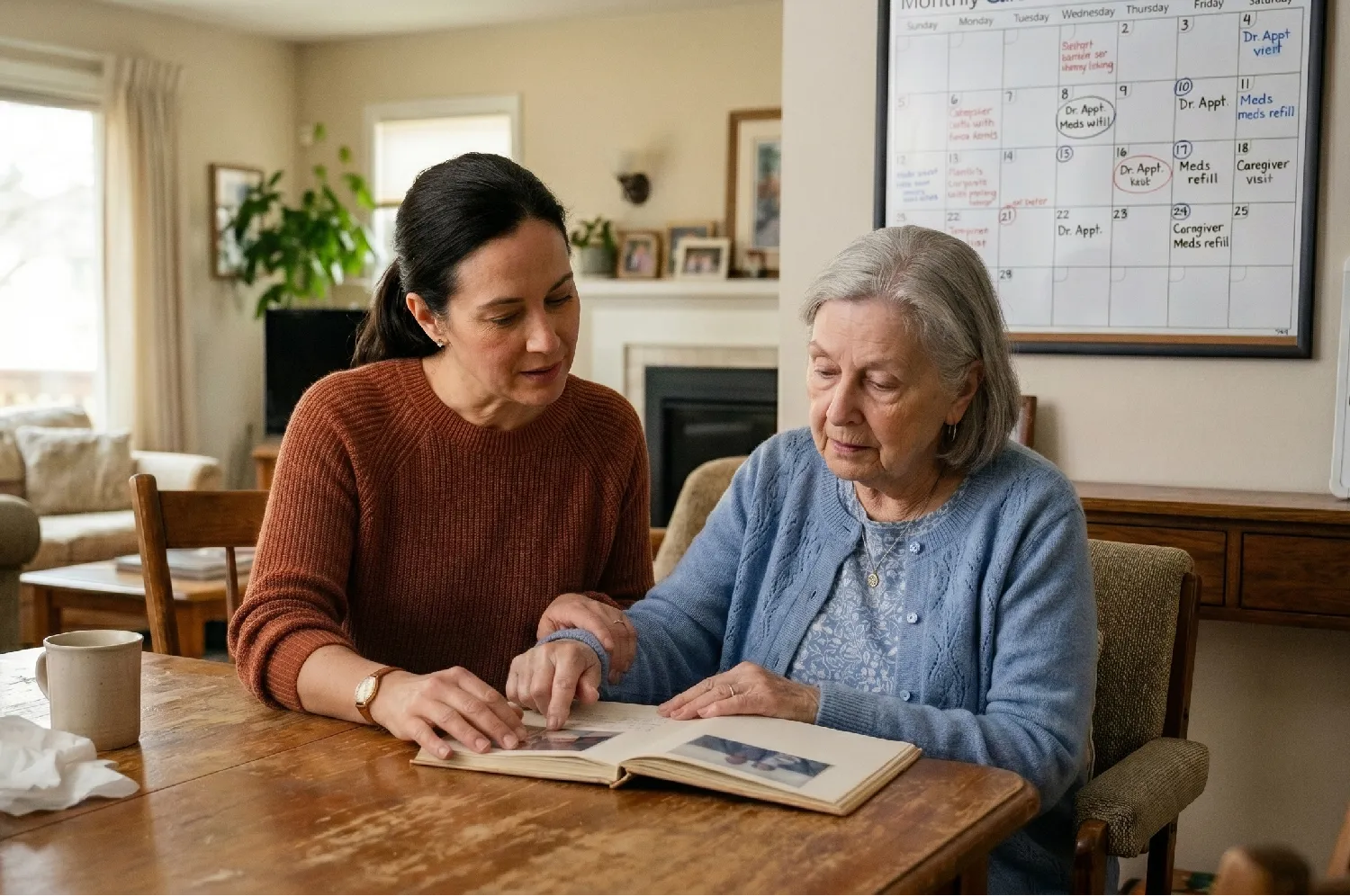
If you care for someone living with dementia, you’ve probably had a moment when you asked yourself “Why is my loved one fighting me on this?”
Maybe it was over a shower. Maybe it was medication. Maybe it was getting dressed, going to the bathroom, eating a meal, or simply walking into another room. You know the task needs to happen, but the person you love says “no,” pushes back, gets upset, or seems to stop halfway through.
Resistance and refusals are some of the most common challenges families and caregivers face in dementia care. They’re also some of the most frustrating because from the caregiver’s side, the situation can feel obvious. The senior needs to shower, eat, or take his or her medicine. Or he or she needs help.
But from the perspective of the person living with dementia, it may not feel obvious at all.
Why Refusals Happen
There are many reasons seniors with dementia may refuse care. Sometimes they feel ashamed because they need help with something they used to do independently. Sometimes they feel stressed because they’re no longer in control. Sometimes they don’t understand what’s being asked of them. Other times, they don’t understand why you’re asking in the first place.
That last piece comes up all the time.
I’ve had caregivers say “I went in to help her shower, and she told me she already showered.” Or “I tried to help her get dressed, and she said she dresses herself.” Or “I made her a meal, and she told me she already ate.”
The hard part is that they may truly believe those things.
When seniors with dementia believe they already took a shower, asking them to shower again doesn’t make sense to them. If I came home tonight and my husband told me I needed to take another shower, I would probably refuse too. I already showered today. I wouldn’t understand why he was asking.
That’s often what is happening in dementia. Their reality and our reality aren’t matching, and when we push from our reality, they push back from theirs.
Compassion Equals Compliance
One phrase I use often when teaching caregivers is this: compassion equals compliance.
That doesn’t mean everything will go perfectly if you’re kind. Dementia is still dementia. But it does mean our approach matters more than we sometimes realize.
Caregiving is hard. It’s natural to get frustrated, especially when you’re trying to help someone who clearly needs help and he or she keeps refusing. You may be thinking “You’re dirty. You need a shower. I’m only trying to help you.” But your loved one may be thinking “Why are you treating me like I cannot do this myself? Why are you bossing me around? Why are you making me feel small?”
When we understand that, we can start to adjust how we approach the task.
One of the biggest mistakes we make is moving too fast. I often say “Too slow, can’t go.” People with dementia often cannot process instructions, movement, and expectations at the speed we want them to. Their brains may not be able to keep up with multistep tasks, especially if we’re talking quickly or rushing them physically.
A simple task to us may not be simple to them.
When “Almost There” Becomes the Hardest Part
One of the most frustrating situations for caregivers is when seniors don’t refuse right away. They seem like they’re going along with the task, and then they stop right at the point where you need them to act.
I’ve had caregivers describe trying to help someone use the bathroom. They get all the way there. They’re standing in the bathroom. Everything seems to be moving in the right direction. Then, when it’s time to sit on the toilet, the person stops.
That can feel even more frustrating than if the individual had refused in the living room, because now you feel like you were so close. You thought your loved one understood. You thought the task was going to happen. Now you may have to leave the bathroom, regroup, and try again two or three more times.
That kind of resistance often means the person doesn’t fully understand what’s happening or doesn’t feel safe enough to continue. Your loved one may not be trying to make things harder. He or she may simply be stuck.
Avoiding the “No”
Another thing I teach caregivers is that if you can prevent the word no, you often should.
Once someone says no, it’s very hard to turn that “no” into a “yes.” This is true in dementia care, and honestly, it’s true in life.
If you walk in and say “You have to take a shower,” you may get an immediate “no.” Once that happens, the person may dig in. His or her feet are planted and mind is made up.
Sometimes the better approach isn’t to start with the demand. It may be offering a choice, asking for help, or changing the way the task is introduced. Instead of making seniors with dementia feel like something is being done to them, we want to help them feel involved in what is happening.
Are We Pushing Our Agenda?
A lot of resistance happens because we’re focused on our agenda.
We need to get them dressed now. We need to leave for an appointment. We need the shower done before lunch. We need them to eat because the food is ready.
Those needs may be real, but they may not match where the person with dementia is in that moment.
I once talked about a woman who took a very long time to button her sweater. From the outside, it would’ve been easy to step in and do it for her. It would’ve been faster. But when we looked at the task more carefully, we realized buttoning the sweater was the part she could still do. It was the part that made her feel like she was dressing herself.
So instead of taking over the whole process, the caregiver helped with the easier layer underneath and let her button the sweater. If you asked that woman, she would tell you she dressed herself. And in many ways, she did. She did the part that mattered most to her.
This is the kind of middle ground we have to look for. Can we get part of the task done and still give them some control? Can we help without taking everything away?
They May Be Matching Your Emotions
People with dementia often mirror the emotions around them. If we come in rushed, frustrated, tense, or angry, they may give that same energy right back.
When I worked in memory care, anytime there was an outburst or a refusal, one of my first questions to staff was “What did you do?” Not because the staff meant to cause a problem but because people with dementia are often reacting to something. They may be reacting to our tone, our body language, our pace, or the way we approached them.
One caregiver once shared that he had to learn how to calm himself down while caring for his wife. He realized that if he was worked up, she became worked up. If he stayed calm, she was more likely to stay calm too. He even used a breathing technique where he pressed his thumb and pinky together to take a deep breath before responding.
He learned that controlling himself helped the situation more than trying to control her.
That isn’t always easy. Sometimes the person with dementia forgets the argument and the caregiver carries it for the rest of the night. That’s why taking a minute before you walk into a difficult task can make such a difference.
Asking Instead of Telling
There’s a big difference between asking and telling.
“You have to get dressed” feels very different from “Can you help me get ready so we can go?”
“You need to eat this” feels very different from “Will you try this for me?”
This is especially important for adult children caring for a parent. In your parent’s mind, his or her role may still be to care for you. When you come in and start telling your parent what to do, it can feel unnatural and upsetting. Your parent may feel like you think he or she is a child.
I’ve seen daughters lovingly try to help their mothers get dressed, putting on sweaters and scarves because they want them to be warm and safe. The daughter isn’t trying to be bossy. She’s trying to help. But the mother may sit there rolling her eyes, feeling like her daughter thinks she cannot do anything.
The task still has to happen, but how we do it matters.
Trained caregivers who have experience in communicating with seniors with dementia can be a fantastic resource for family members. If your senior loved one has been diagnosed with dementia and needs help with tasks like meal prep, transportation, medication reminders, bathing, and grooming, reach out to Assisting Hands Home Care, a leading provider of Cincinnati senior home care.
Making the Task Easier before It Begins
Sometimes the best way to reduce resistance is to prepare the environment before the person is even involved.
If you say “Go into the bathroom, brush your teeth, and take your medicine,” that may sound simple to you. But for seniors with dementia, that can be too many steps. They may go into the bathroom and stop there. Then you become frustrated because they only completed the first part.
If you know you’re going to have to walk your loved one through each step anyway, it helps to set things up first. Put the toothpaste on the toothbrush. Have the medicine ready. Remove extra distractions. Then when your loved one arrives, the process is smoother and less overwhelming.
The same is true in the shower. If there are five bottles sitting there, your loved one may pump something from every bottle onto the washcloth. Eventually, it may be better to have just one bottle. Later, it may be better to put the soap directly on the washcloth. At some point, you may need to hand your loved one the washcloth and guide him or her step by step.
The goal isn’t to take over too early. The goal is to remove unnecessary confusion.
I’ve seen people pick up A&D ointment or another tube and squeeze it onto a toothbrush because it looked enough like toothpaste. In a memory care setting, we learned quickly not to leave several similar-looking tubes out as choices. If the person’s brain can no longer sort through those options safely, the environment needs to do some of that work for the individual.
Living with dementia can make it difficult for seniors to manage everyday tasks on their own. Certain age-related conditions can make it more challenging for seniors to age in place safely and comfortably, but 24-hour home care experts are available around the clock to help Cincinnati seniors manage their health. At Assisting Hands Home Care, we take measures to help seniors prevent illness and injury by assisting with exercise and mobility, preparing nutritious meals, helping with bathing and other personal hygiene tasks, and much more.
Looking for the Unmet Need
Sometimes refusal has nothing to do with the task itself. Sometimes there’s another need getting in the way.
They may be hungry, thirsty, cold, too hot, uncomfortable, overstimulated, or needing to use the bathroom. If that need isn’t met, your loved one may not be able to move on to what you’re asking him or her to do.
Bathroom needs are a big one. People with dementia may not be able to tell you they need to go, but their bodies may still show it. They may fidget, rub their legs, shift in their seats, cross and uncross their legs, or touch their bodies in a way that gives you a clue.
We notice these cues in little kids all the time. We call it the “pee-pee dance.” Adults can have their own version of that too.
If seniors need to go to the bathroom and we’re trying to get them to eat, take medicine, or shower, their brains may be focused on that bathroom need. Until that’s addressed, they may not be able to cooperate with anything else.
The same is true with light and temperature. If seniors with dementia are sitting in a bright room and the light is bothering them, they may squint, cover their eyes, or become agitated. If they’re cold, they may rub their arms, move their feet, or fidget. If they cannot tell you what’s wrong, their behavior may be the only communication you get.
The Grace of Saying You’re Sorry
One of the most useful skills in dementia care is learning how to say you’re sorry, even when you didn’t do anything wrong.
That sounds hard because it is hard.
I recently went to a family’s home to do an assessment for home care. The woman had dementia, and at first everything seemed fine. I asked her a few simple questions, and she answered them. Her husband answered some questions too.
Then suddenly, she became very upset. She said I had busted into her house, barreled in, berated her, made fun of her, and asked crazy questions.
None of that had happened.
But in her reality, it had. She felt threatened. She didn’t understand my purpose there. As I asked questions and spoke with her husband, I stopped feeling like a friendly visitor and started feeling unsafe to her.
So I apologized.
I told her I was sorry. I said I should have asked permission. I told her I was wrong to make her feel that way. Her husband looked at me like “You didn’t do anything.” But I knew rationalizing with her wouldn’t help.
If I had said, “I didn’t barge in here. Your husband invited me. I only asked five questions,” we probably would have gone round for round. Instead, I met her where she was.
Her whole demeanor changed. She told me I should feel sorry, and she appreciated that I apologized. From that point on, she was sweet as pie.
That’s the power of stepping out of the argument and into their reality.
Resistance and refusals in dementia care aren’t usually about someone trying to make life harder. More often, they’re a sign something isn’t making sense, something feels threatening, or something in the environment or approach needs to change.
Seniors with dementia may feel ashamed. They may feel rushed. They may not understand the task. They may believe they already did it. They may be cold, hungry, overwhelmed, or afraid. They may simply be trying to hold on to control in a world that feels less and less familiar.
As caregivers, we cannot control every outcome. But we can control our approach. We can slow down. We can ask instead of tell. We can simplify the environment. We can look for unmet needs. We can apologize, even when we know we didn’t do what they think we did.
Most of all, we can remember that compassion often gets us further than correction.
And in dementia care, that can make all the difference.
Even when families have the best intentions, caring for a senior loved one with dementia can be challenging. Fortunately, Assisting Hands Home Care is here to help. We are a leading provider of dementia care Cincinnati families can trust. You can take advantage of our flexible and customizable care plans, and our caregivers always stay up to date on the latest developments in senior care. To create a customized in-home care plan for your loved one, call us today.
Want to hear more of my advice about dementia care? To join my monthly Real Talk webinar, register here.