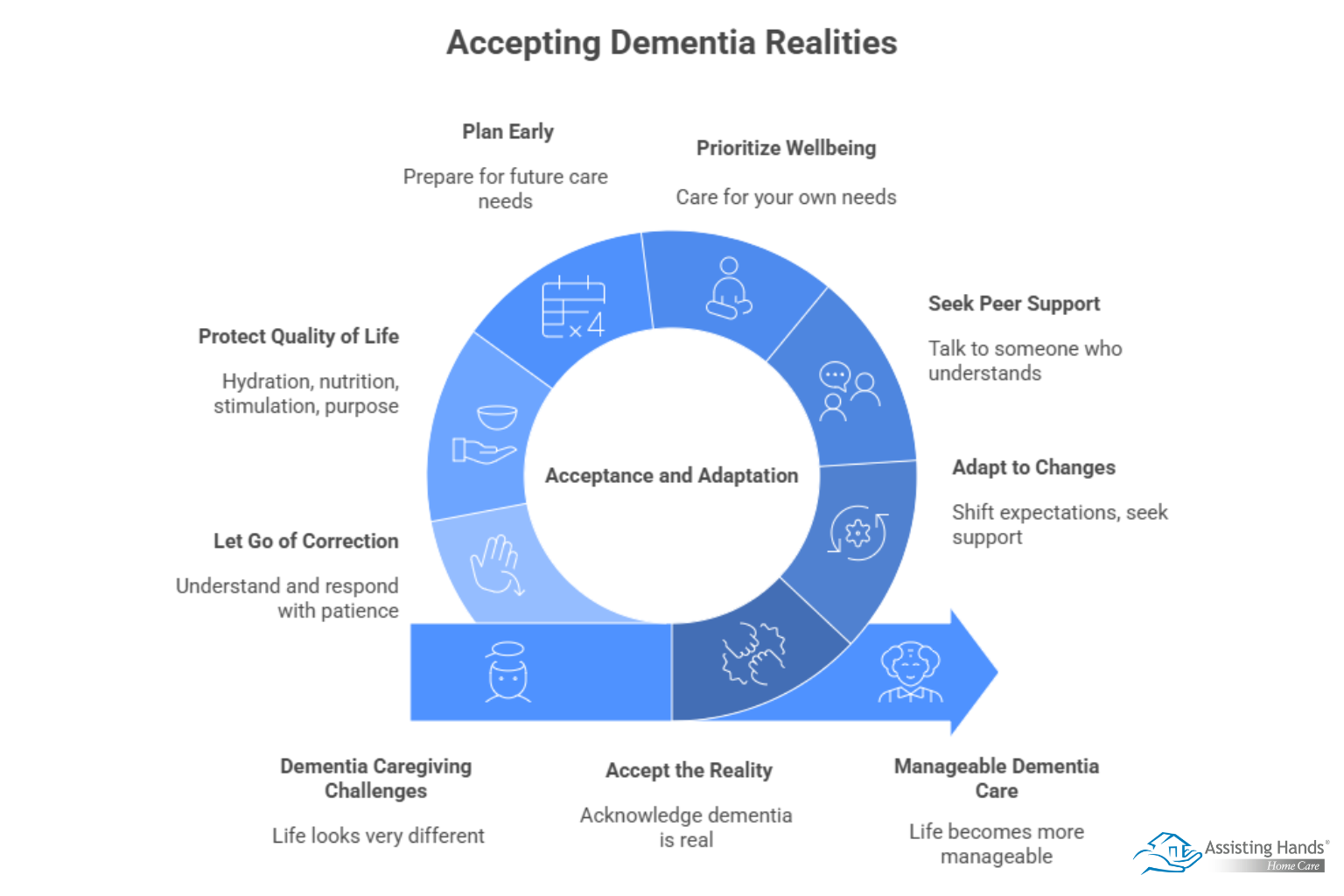
If you’ve ever sat back and thought “This isn’t how I thought things would go,” you’re in good company. Dementia caregiving has a way of slowly changing everything until one day you realize life looks very different than it used to. There’s no perfect plan for this journey. What there is, though, is acceptance of the reality and adaptation to the changes that come with this disease. And while neither comes easily, both can make life more manageable.
After years of working with families, running support groups, and caring for people living with dementia, I’ve learned this much: acceptance doesn’t mean liking what’s happening. It means stopping the internal tug of war long enough to say “Okay, this is real. Now what do we do?”
Why Acceptance Is So Important
Acceptance doesn’t take dementia away, but it can ease suffering for both the person living with dementia and the family member caring for him or her. When acceptance is present, anxiety tends to decrease, emotions feel more manageable, and everyday decisions become a little clearer and kinder.
Without acceptance, both sides struggle in different ways. A person with dementia may feel pushed to “do better,” defend him or herself, or live up to expectations that no longer match his or her abilities. At the same time, caregiving family members may avoid asking for help, refuse services, or take on far more than they realistically can. Over time, this often leads to exhaustion, resentment, and burnout.
Denial is closely tied to non-acceptance and often shows up as anger, defensiveness, blame, or unrealistic expectations. Families say things like “My dad is in denial” or “If my mom would just accept this, things would be easier.”
Here’s the hard and tender truth: you cannot accept dementia for someone else. Seniors living with dementia have their own emotional journeys, and they may or may not ever reach acceptance. What’s possible is for caregiving family members to accept the reality of the disease themselves, shift expectations, seek support, and respond with more patience and compassion for everyone involved.
5 Reasons People with Dementia Often Don’t Accept a Diagnosis
One of the biggest frustrations for families is watching a loved one insist nothing is wrong,
even after testing and clear conversations with doctors. There are very real reasons this
happens:
1. Lack of awareness
Dementia can damage the part of the brain responsible for self-awareness. Many people truly cannot see their own impairment. This isn’t denial or stubbornness. It’s the disease.
From their point of view, they feel normal. Everyone else seems wrong.
2. Memory loss
Even when a doctor explains the diagnosis clearly, short-term memory loss means the information often doesn’t stick. Families will say “She went through hours of testing and still tells people nothing is wrong.”
Sometimes the person doesn’t even remember the appointment happened. Other times the individual remembers pieces but not the conclusion. Each reminder feels new and upsetting.
3. Fear and self-protection
Many people sense something is changing long before they can explain it. To protect themselves, they may withdraw, stop participating, or stop talking altogether.
Others become very good at masking symptoms, especially at doctor visits. They answer questions the way they think they should, not the way things really are, because they’re afraid of losing control.
4. Stigma and generational beliefs
For many older adults, dementia is tied to shame and fear. Losing one’s mind feels worse than losing one’s body. I’ve heard people say “I would rather lose a leg than my mind.”
There’s also a deep fear of having decisions taken from them. That fear makes acceptance feel terrifying.
5. Impaired reasoning
Dementia affects logic. Even when symptoms are obvious to everyone else, they may never add up for the person experiencing them. You cannot rationalize with someone whose brain can no longer reason the way it once did.
This leads to a painful truth for caregivers. Your loved one may never accept the diagnosis the way you want him or her to. Accepting that is part of your journey too.
How Caregivers Are Half the Equation
I say this often because it matters. The person with dementia is only half of the equation. The caregiver is the other half. You’re human. Your emotions are part of this. Denial, anger, sadness, grief, and fear all show up along the way. One thing I encourage caregivers to do is write things down. When emotions run high, facts and feelings get mixed together. Writing can separate the two.
Education matters too, but it doesn’t need to be overwhelming. Learn in the way that works best for you—books, podcasts, conversations, or support groups. I write this article monthly based on my “Real Talk” webinar. If you find value in this article, I’d encourage you to register for the next session here.
And please, find peer support. There’s nothing like talking to someone who truly understands what you’re carrying. I’m happy to help connect you with a support group or a fellow caregiving family member.
Family caregivers need to care for their own wellbeing. If you’re caring for an aging loved one and are feeling overwhelmed, consider hiring a professional caregiver to provide Cincinnati respite care. To prevent burnout, you can turn to Assisting Hands Home Care. One of our professional caregivers can assist your loved one at home while you take a nap, go to work, run errands, or go on vacation.
How Their Losses Become Your Gain
This is one of the hardest things to accept. Everything your loved one can no longer do still has to be done by someone else.
If your loved one cannot drive, someone has to drive. If your loved one cannot manage bills, someone has to step in. If your loved one cannot get dressed independently, someone has to help. In spousal relationships, this often falls on a partner who’s aging too.
I see caregivers hanging on by a thread because they took everything on alone. Planning early, when possible, changes the emotional weight of caregiving. Sometimes the gain doesn’t have to be another person. Sometimes it’s routines, tools, or small interventions that make daily life easier.
Caring for a loved one with dementia can be challenging, but compassionate help is available. If your senior loved one has been diagnosed with a serious condition and needs help with tasks like meal prep, transportation, medication reminders, bathing, and grooming, reach out to Assisting Hands Home Care, a leading provider of Cincinnati in-home care. We also offer comprehensive care for seniors with dementia, Alzheimer’s, and Parkinson’s.
Grieving while Your Loved One Is Still Here
Many caregivers say something that surprises them: “I feel like I’m grieving someone who’s still alive.”
You grieve the spouse you once had. Or the parent you thought would share life milestones with you. I hear this often from adult children who become grandparents and cannot share that joy with their own parents.
That grief is real. It deserves space and understanding.
Adapting without Trying to Fix
Dementia is progressive. You cannot fix it. You can, however, work to protect quality of life.
I believe people need four things: hydration, nutrition, stimulation, and purpose. When those needs are met, cognitive decline can slow. It cannot stop, but it can be gentler.
One of the biggest adaptations is letting go of correction. Many spouses correct not because they want to be right but because they desperately want their loved ones to be right again. Understanding that changes how we respond.
Routines help both the person with dementia and the caregiver. So does allowing independence where it’s still possible.
Sometimes adaptation means letting go of the old relationship and building a new one. That’s hard, especially when it’s your spouse or your parent. But when you meet your loved one where he or she is today, things often feel lighter.
Dementia care isn’t about doing everything right. It’s about doing the best you can with the information you have today.
Acceptance doesn’t come all at once. Adaptation takes time. Some days will still be hard. But when you stop fighting what is and start working with it, life becomes more manageable.
And that matters.
Even when families have the best intentions, caring for a senior loved one with dementia can be challenging. Fortunately, Assisting Hands Home Care is here to help. We are a leading provider of dementia care Cincinnati families can trust. You can take advantage of our flexible and customizable care plans, and our caregivers always stay up to date on the latest developments in senior care. We will work with you to create a customized home care plan that’s suited for your loved one’s unique needs. Call the Assisting Hands Home Care team today.