If you’ve ever sat back and thought “Something about this just doesn’t feel right,” you’re in good company. Families often reach out and say “Kate, she just completely changed overnight.” And that moment is scary because you don’t know what you’re looking at. Is it dementia getting worse? Is it depression? Is it something medical that can be treated?
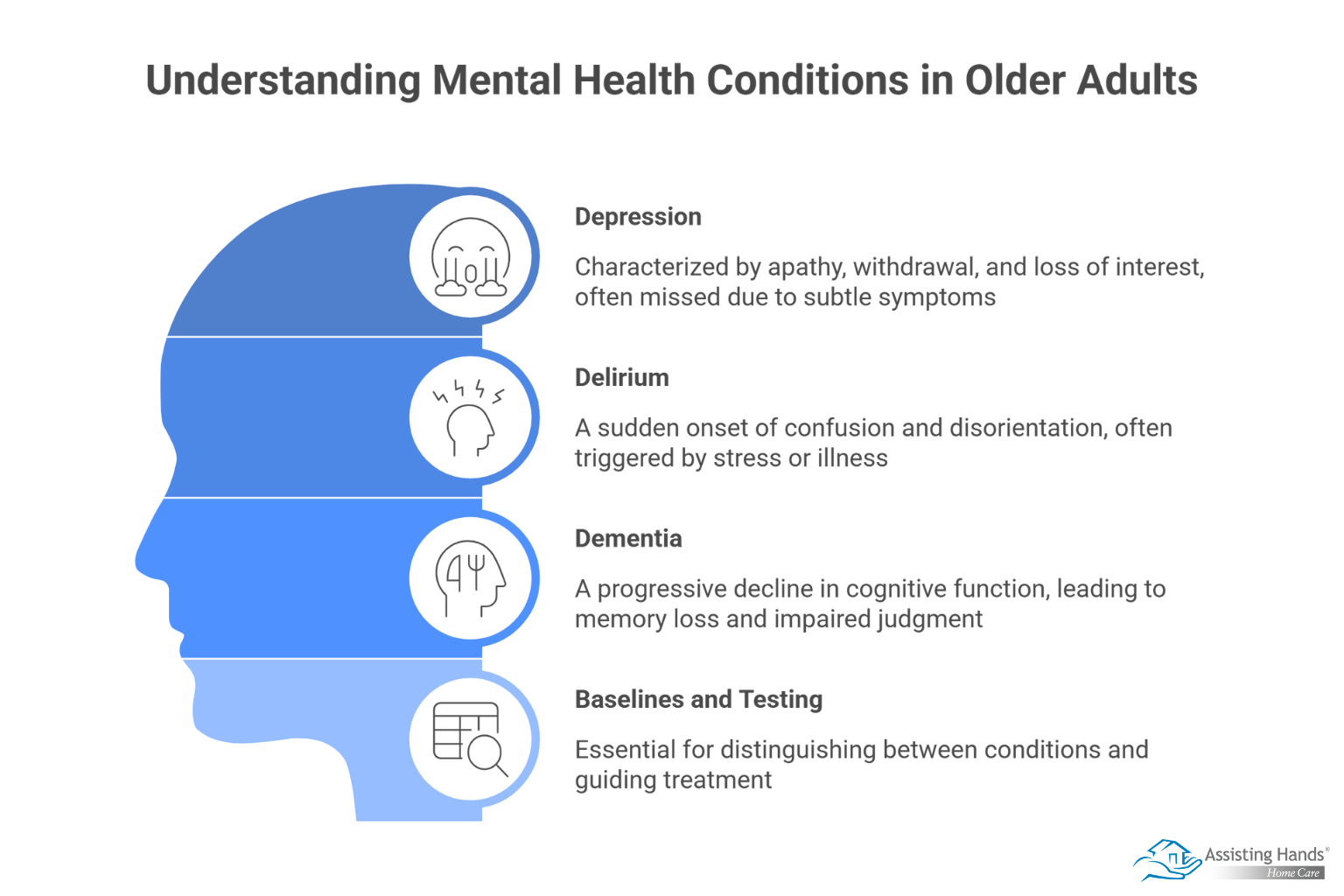
That’s why I wanted to talk about what I call the three Ds: depression, delirium, and dementia. These are the three most common mental health conditions among older adults, and they overlap so much that they often go unrecognized. They look alike. They get confused. And families are left trying to sort through something that feels impossible.
After years of working with older adults and supporting families through this journey, I’ve learned that understanding the difference between these three conditions can bring a lot of clarity. Not because it makes things easy, but because it helps you respond with less fear and more confidence.
Why Depression Often Gets Missed
Depression isn’t a normal part of aging, but it’s incredibly common in older adults, especially when dementia is also present. The hard part is that depression doesn’t always look like sadness. Sometimes it looks like apathy. Loss of interest. Withdrawal. A person who just doesn’t seem like him or herself anymore.
Depression becomes even more common in rehab or nursing home settings. Families tell me all the time “I’m really worried about my mom going into skilled therapy, because the last time she did, she got really depressed.” And that fear makes sense. Those settings often involve major loss. Loss of independence, loss of routine, loss of role, and grief over health decline.
Sometimes older adults are limited not only by what they can do physically but also by rules meant to keep them safe. “You can’t get up alone. You can’t go to the bathroom by yourself. You’re a fall risk.” Even when those rules are necessary, the emotional impact is real.
And there’s another piece families don’t always think about. In skilled rehab, a person may only receive one hour of therapy a day. That leaves 23 hours unfilled. If those hours aren’t filled with stimulation, interaction, and meaningful activity, it’s easy for someone to sink into isolation and depression.
The good news is that depression is treatable. Movement, medication, social engagement, treating pain, and enhancing sleep. All these small changes can significantly boost quality of life.
If you have a senior loved one who needs help maintaining a high quality of life while aging in place, reach out to Assisting Hands Home Care, a leading provider of senior home care Cincinnati families can trust. Our caregivers help seniors focus on healthy lifestyle habits such as eating nutritious foods, exercising regularly, and maintaining strong social ties, and we offer mentally stimulating activities that can boost cognitive health and delay the progress of dementia.
What Delirium Really Is
Delirium is the one that often shocks families the most, because it comes on suddenly. Delirium isn’t a disease. It’s the brain’s response to stress. I often describe it as a perfect storm.
Families will say “She really lost it in the ER” or “He was completely out of it when we got to the hospital.” That’s because hospitals are one of the biggest triggers for delirium. The environment plus acute illness can overwhelm a vulnerable brain.
Infection is one of the most common causes. If you’ve ever heard those three letters (UTI), you know what I mean. Families will say “Kate, she had a UTI, and she completely changed.” And then once the infection clears, they’re amazed at how much better their loved one becomes.
Delirium can also be triggered by surgery, anesthesia, medication changes, dehydration, uncontrolled pain, constipation, urinary retention, and sleep deprivation. Hospitals disrupt sleep constantly with alarms, bright lights, overnight vital sign checks, and room changes.
Even something as simple as not having glasses or hearing aids can throw someone into confusion. When the brain can’t correctly interpret the environment, it fills in the gaps and often fills them in wrong.
Here’s the key thing to remember: delirium is urgent, but it’s often reversible. The goal is to find the cause, calm the brain, reassure the person, and protect him or her while his or her system stabilizes.
Never assume delirium is “just dementia.”
Dementia Is Different
Dementia is different from depression and delirium because it’s progressive and persistent. It doesn’t usually happen overnight. Alzheimer’s disease is the most common type, and risk increases significantly with age.
Symptoms begin gradually. It could look like forgetting recent events, difficulty with familiar tasks, confusion, personality changes, or impaired judgment. Over time, individuals may become unable to care for themselves.
One of the truest statements I’ve learned is this: If you’ve met one person with Alzheimer’s disease, you’ve met one person with Alzheimer’s disease. It looks different in everyone.
And in later stages, families often say something heartbreaking but honest: “I feel like I’m grieving someone who’s still alive.” That grief is real. Dementia changes the brain, but it never changes the heart.
If your loved one has been diagnosed with Alzheimer’s disease, help is just a phone call away. For reliable Alzheimer’s care in Cincinnati, families can turn to Assisting Hands Home Care. We are a leading provider of professional memory care designed to help seniors maintain a higher quality of life. In addition to Alzheimer’s care, we also provide comprehensive dementia, Parkinson’s, and stroke care. From revolutionary care programs to compassionate and dedicated caregivers, we can meet all of your Alzheimer’s care needs.
Why Baselines and Testing Matter
Families sometimes ask “Does testing really matter?” And it does. We need a baseline. Depression can mimic cognitive decline. Delirium can look like sudden progression. Testing helps doctors determine what’s treatable, what’s temporary, and what’s part of the disease trajectory.
Without a baseline, every change feels catastrophic. With one, we can ask better questions.
Depression can be treated, and delirium can often be reversed. Dementia cannot be cured today, but that doesn’t mean nothing can be done. Quality of life can still be protected in meaningful ways. Paying attention to hydration, nutrition, stimulation, purpose, routine, and reassurance makes a real difference. The goal isn’t to do everything perfectly. It’s to understand what you’re seeing, respond with compassion, and resist the urge to assume the worst. Knowledge doesn’t remove the difficulty of this journey, but it can remove some of the fear, and that truly matters.
If your loved one has Alzheimer’s or another form of dementia, compassionate professional in-home care is available. Aging in place can present a few challenges for seniors living with dementia. However, with professional dementia care that offers Cincinnati families peace of mind, they can still live independently at home. Families can rely on Assisting Hands Home Care to provide their elderly loved ones with mental and social stimulation, timely medication reminders, assistance with meal prep, and much more. Our caregivers are available around the clock to help your loved one live a happier and healthier life. We will work with you to create a customized home care plan that’s suited for your loved one’s unique needs. Call the Assisting Hands Home Care team today.