If you spend enough time caring for someone with dementia, you eventually notice moments that make you pause. Families will say things like “Kate, she used to love going out to dinner, and now she can’t stand it” or “He keeps saying the TV is too loud when it’s barely on.” And you start wondering what exactly changed.
Most people assume dementia is only about memory loss. But the brain does a lot more than store memories. It’s also responsible for interpreting everything we see, hear, taste, smell, and feel. When the brain begins to fail, those signals don’t always make sense anymore. The world can start to feel confusing, overwhelming, or just plain different.
Understanding these sensory changes doesn’t solve everything, but it helps families make sense of behaviors that otherwise feel mysterious.
When the Brain Changes How We See
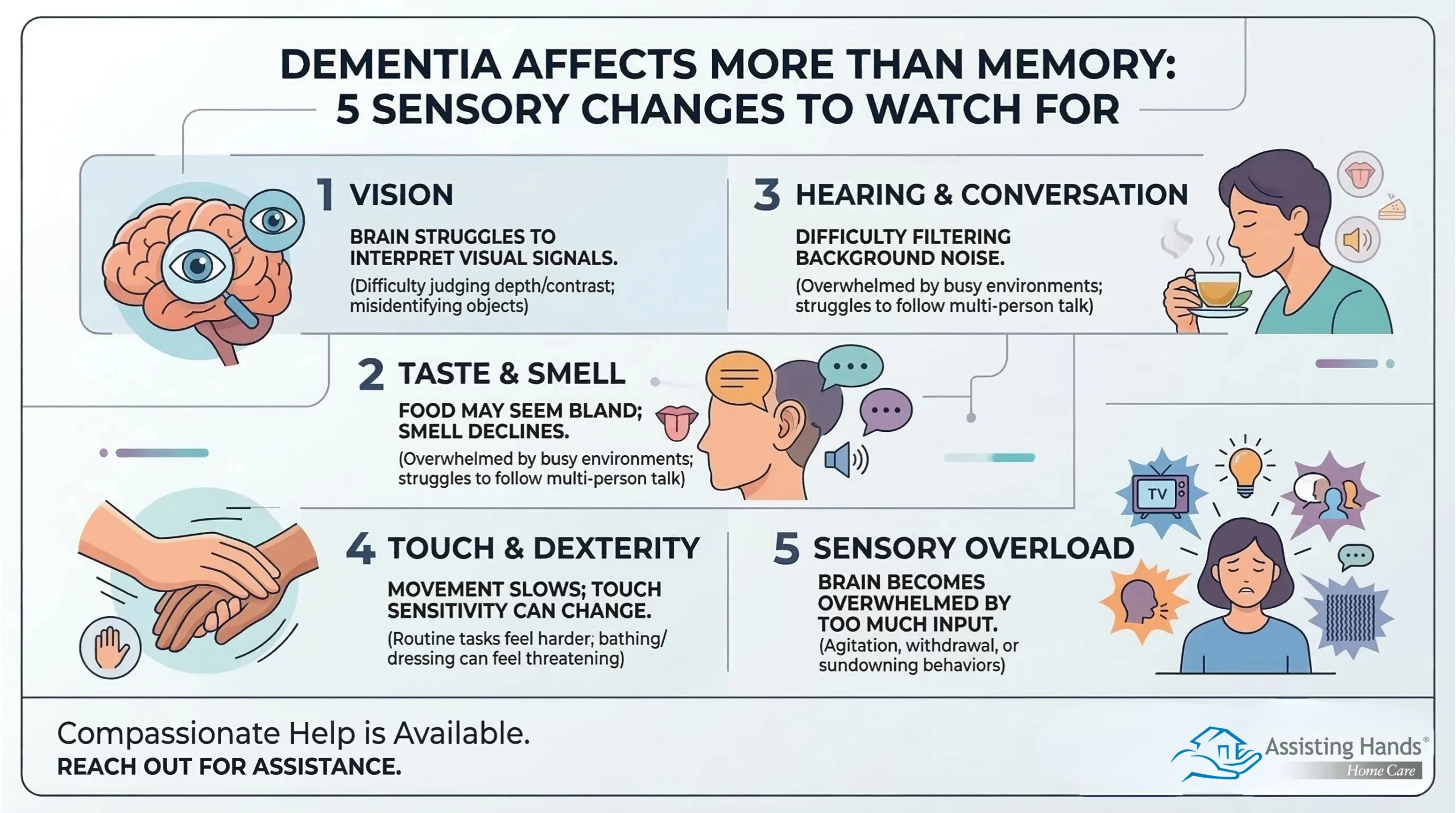
One of the biggest shifts happens with vision. The eyes themselves may still work, but the brain struggles to interpret what it’s seeing.
Families will sometimes notice their loved one hesitating at a doorway or stopping at a small threshold on the floor. It might look like the senior is being stubborn or cautious, but often it’s due to difficulty judging depth and contrast. That small strip on the floor might look like a step. Stairs can suddenly feel risky.
I’ve even seen situations where a coat draped over a chair is mistaken for a person. When the brain can’t put the whole visual picture together, everyday spaces become harder to navigate.
That’s why activities like driving, reading, cooking, or even watching TV can gradually become more difficult.
When Food Stops Being Enjoyable
Families also notice changes around food.
Someone who used to enjoy meals might suddenly lose interest in eating or might start preferring sweets much more than he or she used to. That’s often because taste sensitivity declines. Food can simply seem bland.
And when eating stops being enjoyable, people sometimes eat less or make poor food choices. That can lead to weight loss, weakness, and eventually an increased risk of falls.
Smell plays a role here too. Seniors who can’t smell well may not notice spoiled food, smoke, gas, or even body odor. They might also struggle with things like recognizing when clothing or bedding needs to be changed.
Certain age-related conditions can make it more challenging for older adults to age in place safely and comfortably, but experts in 24-hour care for Cincinnati seniors are available around the clock to help aging adults manage their health. Whether your loved one is living with dementia or recovering from a stroke, you can trust the professional caregivers from Assisting Hands Home Care to enhance his or her quality of life.
When Conversation Gets Harder
Communication changes can be frustrating for everyone involved.
Imagine trying to follow a conversation in a busy restaurant where several people are talking at once. Now imagine your brain struggling to filter which voice matters.
For someone living with dementia, multiple conversations, background noise, or even a loud TV can make it very hard to process what people are saying. On top of that, the person with dementia may know what he or she wants to say but can’t find the words.
That combination can lead to frustration, less conversation, and sometimes withdrawal.
Touch, Movement, and the Body
Changes in touch and body awareness are another piece families don’t always expect.
Dexterity can slow down. Movements take longer. The brain simply isn’t sending the same signals to the body anymore.
At the same time, some people become more sensitive to touch, even though caregivers often need to touch them to provide help with bathing, dressing, or other care. Others may not notice pain as easily, which means injuries can go unreported.
Activities that once felt routine, such as visiting friends, climbing stairs, playing golf, or going out with family, may suddenly feel much more difficult.
When the Brain Can’t Filter the World
As dementia progresses, the brain also has difficulty filtering incoming information.
Think about environments that are already stimulating: loud televisions, bright lights, busy patterns, several people talking at once. Most of us can tune that out. A brain affected by dementia often can’t.
When too much input comes in at once, the brain becomes overwhelmed. Families might see agitation, withdrawal, or what they describe as sundowning behaviors.
This sensory overload also explains why some situations suddenly become difficult.
Take bathing, for example. Families often say “She’s just being stubborn about taking a shower.” But for someone with dementia, the experience can feel very different. Water may sound extremely loud. Temperature can feel intense. Touch may feel threatening. What looks like resistance is often sensory overload.
“My Loved One Doesn’t Recognize Me”
One of the most heartbreaking moments families describe is when a loved one stops recognizing them.
A daughter might be mistaken for a sister. A spouse may seem like a stranger.
Families naturally experience this as rejection, but neurologically, the brain may simply be unable to match the face it sees with the memory it once stored. The connection isn’t working the way it used to.
Caring for a loved one with dementia can be challenging, but compassionate help is available. If your senior loved one has been diagnosed with a serious condition and needs help with tasks like meal prep, transportation, medication reminders, bathing, and grooming, reach out to Assisting Hands Home Care, a leading provider of Cincinnati senior home care. We also offer comprehensive care for seniors with dementia, Alzheimer’s, and Parkinson’s.
A Shift in How We Respond
Once families understand what’s happening in the brain, the next step is figuring out how to respond.
One of the biggest mindset shifts I encourage is this: instead of focusing on what someone can’t do anymore, look for ways to help your loved one stay involved in what he or she can still do.
Sometimes we jump in and do everything for someone because it’s faster or easier. But that can unintentionally take away independence.
Instead of doing something for your loved one, try doing it together. Ask questions like “Can you show me how you do this?” or “Can you help me with this for a minute?” It allows your loved one to stay included and feel useful.
And inclusion matters more than we realize. A survey by the international group Dementia Friends asked both people living with dementia and family caregivers about the biggest impact of a diagnosis. Both groups gave the same answer: they felt left out.
Sometimes exclusion happens because environments are overwhelming. Crowded stores, loud restaurants, or events without handicap accessibility can make participation difficult. But small adjustments can help. Think shopping at quieter times, choosing smaller restaurants with simpler menus, or attending a practice or scrimmage instead of a crowded sporting event.
The goal isn’t perfection. It’s helping your loved one remain part of life as much as possible.
One Thing I Always Remind Families
At the center of all of this is one simple truth: dementia is brain failure.
This means behaviors that feel frustrating, confusing, or even hurtful are often symptoms of a brain that simply can’t process information the way it once did.
Because of this, one of the most helpful things caregivers can do is give up the need to be right. Arguing, correcting, or trying to force logic into a situation usually makes things harder for everyone.
Sometimes the best approach is simply listening, reassuring, and letting someone feel heard, even if what he or she is saying isn’t completely accurate.
Understanding what’s happening in the brain doesn’t make the journey easy. But it does make it easier to respond with patience, compassion, and a little more understanding for the person walking through it.
Even when families have the best intentions, caring for senior loved ones with dementia can be challenging. Fortunately, Assisting Hands Home Care is here to help. We are a leading provider of dementia home care Cincinnati families can trust. You can take advantage of our flexible and customizable care plans, and our caregivers always stay up to date on the latest developments in senior care. We will work with you to create a customized home care plan that’s suited for your loved one’s unique needs. Call the Assisting Hands Home Care team today.
Want to hear more of my dementia advice? To join my monthly Real Talk webinar, register here.